
Can Anxiety Therapy Help Me Control My Anxiety? A Denver Therapist’s Guide
Despite our best efforts at mindfulness, breath control, rationalization, or avoidance, anxiety demands that our bodies pay attention to it. Why must it be so consuming? When our body’s stress activation system is turned on (aka our fight or flight system) cortisol is produced to catalyze motion and navigation away from danger.
The survival of our species relies on anxiety cues for protection, but in our daily lives - typically absent from life threatening peril - anxiety can feel a lot more demonizing than like an ally.
Anxiety becomes maladaptive when our body’s stress activation system is chronically turned on or hyper-responsive to non-threats.
So, the large question looms: can we control our anxiety if so much of it is rooted within our physical being?
The answer from a Denver anxiety therapist: Yes, by shifting our perception of it and managing our responses to it.
Viewing Anxiety as a Protection, Not Just a Symptom
At CZ Therapy Group, we use the model of Accelerated Experiential Dynamic Psychotherapy (AEDP) to understand emotional, behavioral and cognitive responses to trauma, depression and anxiety.
Many traditional approaches characterize anxiety as a primary emotion and focus solely on eliminating it in the short term through tools like:
Box Breathing
Progressive Muscle Relaxation
Grounding Exercises
While these tools are important and certainly beneficial, they do not look for emotions under the “mask” of anxiety- i.e., the core emotions listed below (see image of the Change Triangle). Instead of sending away anxiety, we believe it’s crucial to support clients in identifying where it manifests in their body as sensations, and cluing in to messages the anxiety may hold about ourselves, others, or the world.
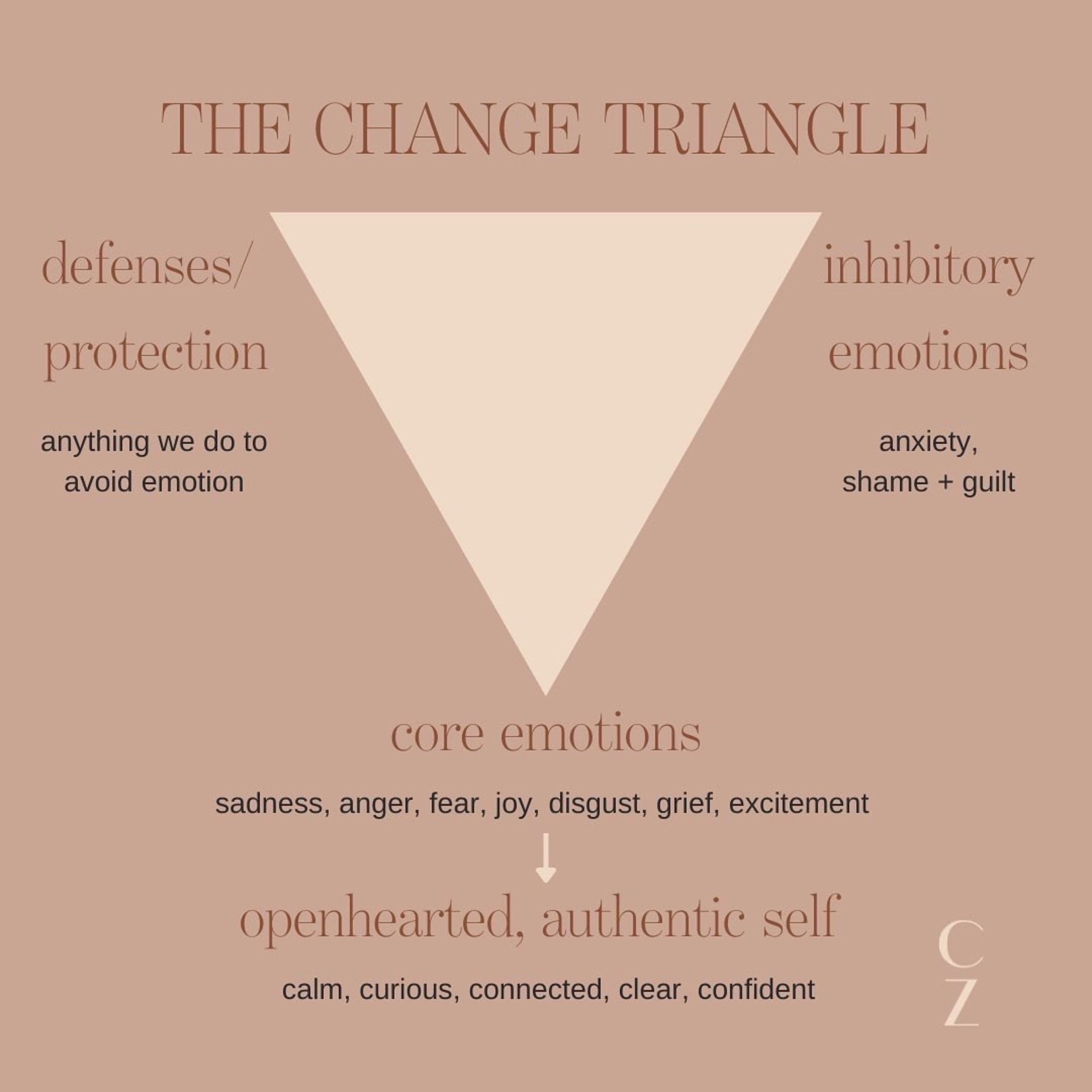
The Change Triangle: Moving Beyond the Mask of Anxiety
To understand why anxiety feels so uncontrollable, we use a tool called The Change Triangle. In this model, anxiety is viewed as an Inhibitory Emotion. Its job is to block us from feeling deeper, core emotions (like grief, anger, or joy) that might feel too overwhelming for our system to handle at the moment.
By working with an anxiety therapist who takes a similar approach, you can learn to move through the anxiety "mask" to reach the core emotions underneath. When we address the root emotion, the "need" for the anxiety response often diminishes naturally, and connection to your most authentic self becomes within reach.
The Change Triangle in Action: A Real-Life Example
To understand how these layers work together, let’s look at a common scenario involving a fictional client named Katie.
1. The Defense & The Anxiety (The Top of the Triangle)
Katie often experiences intense anxiety (Inhibitory Emotion) leading up to her son’s piano recitals. To manage this discomfort, she finds herself becoming overly critical, demanding that her son practice more, or sometimes considering not attending the recital at all (Defenses/Protections). On the surface, it looks like Katie is just "stressed about the performance," but the triangle tells a different story.
2. The Core Emotions (The Bottom of the Triangle)
When Katie allows herself to sit quietly with her therapist and explore the anxiety, she uncovers a deeper layer. She reveals that her son has been bullied at school. Her real struggle isn't about the piano music; it’s a profound worry that if he performs in public, he will be teased again. Underneath the "mask" of anxiety are the Core Emotions of fear and sadness for her child.
3. Connecting with the Authentic Self
Now that we are attuned to Katie’s more vulnerable emotions, the "need" for the critical behavior vanishes. Instead of adding more pressure to her son, Katie can now support him from a place of compassion. By processing her own sadness and fear, she connects with her Openhearted, Authentic Self, allowing her to be the supportive parent she actually wants to be.
Learn more about how the Change Triangle and AEDP therapy can help heal anxiety on our previous blog.
Understanding Locus of Control: Shifting Your Perspective on Anxiety
Another core way we support clients in anxiety therapy is by identifying their Locus of Control.
Simply put, your "locus of control" is how you categorize your influence over your life. It refers to the degree to which you believe you have power over the circumstances that impact you.
Internal Locus of Control: The belief that you have direct influence over the outcomes in your life.
External Locus of Control: The belief that external forces—such as luck, fate, or other people—dictate what happens to you.
Why Your Locus of Control Matters in Anxiety Therapy
When we discuss this concept in a clinical setting, it’s important to remember that these states are not fixed. They exist on a continuum and are shaped by several factors:
The Impact of Trauma: Experiences that take away our autonomy often push us toward an external locus of control as a survival response.
Cultural & Family Modeling: Our views on control are often modeled by our caregivers and our culture. Western, individualistic cultures often gravitate toward an internal lens, while Eastern, collective cultures may lean toward an external lens.
Adaptability: One lens is not inherently "better" than the other. The goal is to move toward a flexible perspective that allows you to take responsibility for what you can change while accepting what you cannot.
Differentiating Between Internal vs. External Locus of Control
The following breakdown explores the attributes of each mindset. As you read through these, try to approach them with curiosity rather than judgment. Ask yourself:
In a state of anxiety, which locus of control do I lean toward?
When I feel grounded and authentic, how does my perception of control shift?
What was modeled for me in childhood by my parents or caregivers?
Which of these attributes feel most aligned with my personal values today?
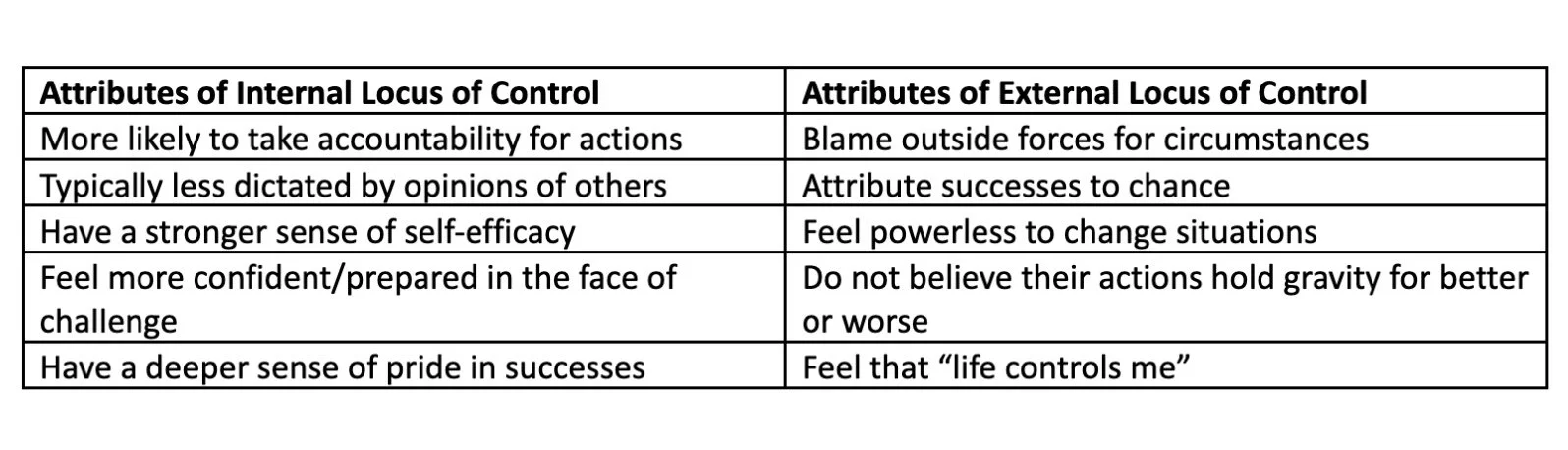
The Role of Anxiety Therapy in Reclaiming Your Locus of Control
Those with an internal locus of control tend to experience greater self-confidence and self-determination. They are also often less susceptible to the long-term physical health impacts of chronic anxiety.
Why is this the case? When we believe we are the authors of our own lives, we become:
Proactive in our Wellness: We are more likely to seek out relationships, attitudes, and habits that reflect our inherent value.
Emotionally Attuned: Instead of meeting anxiety, shame, or anger with avoidance, we learn to respond with compassion and self-regulation.
Finding the Balance: Discernment and Acceptance
Of course, life is not entirely within our hands. There are certainly moments where embracing a lack of control is the healthiest path—such as an unexpected storm canceling an outdoor event.
Anxiety therapy in Denver helps you develop the discernment to know the difference. Our work together empowers you to:
Identify your "Pockets of Control": We focus on the areas where you have absolute agency—specifically your internal self-talk and how you choose to cope with uncomfortable emotions.
Practice Radical Acceptance: For the things firmly outside of your control, we work on establishing healthy boundaries and practicing deep self-compassion. This prevents you from wasting vital energy trying to "fix" the unfixable.
Building Your Holistic Anxiety Support System
Healing from anxiety doesn't just happen in the therapist's office; it happens in the rhythm of your daily life. Alongside regular sessions, I encourage you to curate a self-care routine that feels grounding and restorative.
To help you get started, explore these local resources:
Explore Anxiety Therapy in Denver, CO.
Anxiety therapy can help you explore the way anxiety manifests in your life, unveil its roots, and help you experience growth and transformation towards a more authentic way of living and relating to yourself and others.
Reach out today to explore if anxiety therapy in Denver is right for you! Follow these three steps to get started:
Schedule a free 20-minute consult call to see if anxiety therapy in Denver is a good fit!
Connect with the CZTG anxiety therapist of your choice via a phone consult.
Begin your healing from anxiety!
Meet The Writer: Jordan Kurtz, Anxiety Therapist in Denver, CO.
Jordan Kurtz (she/her) is a Denver anxiety therapist, couples counselor, and staff writer at CZTG. Jordan focuses on therapy for anxiety, trauma, adolescence, and relationships. Her approach is authentic, warm, and affirming, which she interweaves throughout her use of advanced evidence-based modalities, including EMDR, Emotion Focused Therapy for Couples (EFT), and somatic therapy. She provides anxiety therapy in Denver and virtually throughout the state of Colorado. If you’d like to work with Jordan, feel free to reach out to schedule a consultation call.