What Anxiety Really Is (And Why It Doesn’t Just Go Away)
The DSM-5 defines anxiety as “excessive worry and apprehensive expectations,” while the American Psychological Association describes it as an emotion marked by tension, worried thoughts, and physical changes like increased heart rate.
But anxiety isn’t just a set of symptoms—it’s a nervous system response. And for many people, it persists not because something is wrong with them, but because something deeper hasn’t been processed yet.
Below, we break down how anxiety manifests, how we can effectively work with it in anxiety therapy in Denver, and coping skills you can try on your own.
Why Anxiety Happens: The Nervous System and the Change Triangle
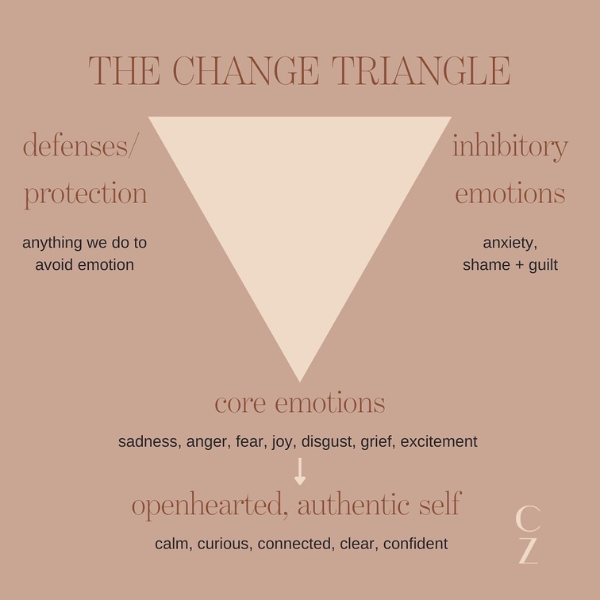
At CZ Therapy Group, we address anxiety and other concerns using Accelerated Experiential Dynamic Psychotherapy (AEDP). AEDP believes that anxiety is rooted in unprocessed core emotions, as opposed to being the singular emotional experience itself, and uses The Change Triangle as a helpful tool to track our emotional experiences and process through the root in order to find healing.
Understanding The Change Triangle
The change triangle posits that when our core emotions (at the bottom of the triangle) are too intense or new to feel – especially in isolation – we often get stuck at the top of the triangle: in anxiety/shame/guilt and in the defenses that we’ve learned keep us safe. Defenses can look like intellectualizing, avoidance, disordered eating, isolation/pulling away from others, use of substances, and more.
Our work in therapy involves uncovering the core emotions at the bottom of the triangle and co-creating enough safety and nervous system regulation to process through them fully. This allows you to access your core and openhearted state and live free from anxiety and a state of protection.
How Anxiety Shows Up in Your Thoughts, Body, and Behavior
Anxiety lives in both our minds and our bodies and moves through us on multiple levels. Recognizing it across all three can help you notice your internal experience more intentionally and respond with care and attunement.
Anxious Thoughts Patterns
You might notice thoughts like:
“I cannot do this”
“I am a loser”
“This is too much”
“I should be able to do more”
“What if ___ happens”
“Everyone is looking at me”
“This will never get better”
“I am scared”
“I look/I will look stupid”
These thoughts can feel like facts, especially in the middle of an anxious spiral. They are not facts. They are your nervous system trying to make sense of an emotion it hasn't been able to fully process yet.
Physical symptoms of Anxiety in The Body
Anxiety is as much a body experience as it is a mental one. Common physical signs include:
Fidgeting or excessive, fast, or repetitive movements
Rapid breathing or heart rate
Trembling, shaking or jitteriness
Tightness in the chest
Sweating
Nausea and upset stomach
If you've ever wondered "why does anxiety cause physical symptoms," this is why: your nervous system is activating its threat response, even when the threat isn't physical. Your body doesn't always know the difference between a predator and an unanswered email.
Behavioral Patterns Connected To Anxiety
Avoiding a person, place, or situation that provokes anxiety
Procrastinating
Social withdrawal
Numbing with alcohol or other drugs
Disordered Eating
Overthinking or perfectionism
These behaviors are protective. And while they provide short-term relief, they work in tandem with the inhibitory emotions - including anxiety - at the top of the triangle, ultimately reinforcing and perpetuating it.
Anxiety vs. Fear: Understanding the Difference
The terms "anxiety" and "fear" are often used interchangeably, and it makes sense why. Their symptoms can feel similar. But they are clinically distinct, and the difference matters in anxiety treatment.
Fear is a core emotion. It's present-oriented, short-term, and adaptive. It shows up in response to a specific and identifiable threat that's happening right now. Think of how your body reacts when you're startled by something. Fear is wired to help you respond.
Anxiety, on the other hand, is an inhibitory emotion. It's future-oriented, broader, and more diffuse. It tends to orbit around threats that are anticipated rather than immediate. When fear asks "How do I respond right now?", anxiety asks "What might happen, and when?"
In anxiety therapy, this distinction is really important. The goal in our work together isn't to eliminate fear. Fear is healthy and informative. The goal is to help you move through fear so anxiety doesn't have to take over and linger.
Types of Anxiety (And How They Show Up in Real Life)
The DSM classifies types of anxiety depending on how our anxiety presents and what it is primarily directed towards or experienced with. Though we will not define all anxiety disorders here, below are common terms often partnered with anxiety and what they mean.
Social Anxiety
Social anxiety involves persistent fear or discomfort in social situations where you might be evaluated by others. This could be giving a presentation, meeting new people, or even eating in front of others. The fear is less about the situation itself and more about being perceived negatively. Social anxiety often leads to avoidance or pushing through with significant distress, and it can interfere meaningfully with daily life and relationships.
Phobias
A phobia is an intense fear or anxiety about a specific object or situation that is disproportionate to the actual risk it poses. Common phobias include fear of flying, heights, needles, animals, storms, or enclosed spaces. Subtypes include animal, natural environment, blood-injection-injury, situational, and other (such as illness or medical procedures).
Panic Attacks
A panic attack is an abrupt, unexpected surge of intense fear or discomfort that peaks within minutes. Symptoms can include heart palpitations, trembling, nausea, dizziness, feelings of unreality (derealization), a sense of being detached from yourself (depersonalization), and fears of "going crazy" or dying. Panic attacks are terrifying in the moment, and a big part of what makes them persist is the anxiety about having another one.
How to Regulate Anxiety in the Moment (Practical Tools That Actually Help)
These tools won't eliminate anxiety permanently, but they can help you get through an acute moment and return to a more regulated state. They are also the kinds of practices that, over time, build your nervous system's capacity to tolerate moments of dysregulation.
Use the Change Triangle to Understand What’s Happening
When anxiety spikes, the Change Triangle can help you get oriented:
Notice where you are on the triangle. Are you in a defense, like avoiding or distracting? Are you in an inhibitory emotion like anxiety or shame? Or can you sense a core emotion underneath?
Notice what is happening in your body and your thoughts.
Get curious about what core emotion might be driving things. Anger? Grief? Fear? It makes sense that your nervous system is working hard to keep you from feeling it.
Bring compassion to yourself. Your nervous system is doing its job. It learned these patterns to protect you.
The “Triple A” mantra: Awareness, Aloneness, Acceptance
This is a simple framework you can return to in anxious moments:
Awareness: Acknowledge the anxiety by naming what you are experiencing. "I am noticing tightness in my chest right now." "I feel myself starting to lose my grounding."
Aloneness: Remind yourself you are not alone in this. "Others feel this way too. This is part of being human."
Acceptance: Practice self-compassion and allow the feelings to be present without fighting them. "What do I need to hear right now? May I be patient with myself. This feeling is hard, and this feeling will pass."
Ground Your Nervous System with Breath and Sensory Tools
Try Box Breathing
Box breathing is one of the most effective and research-supported tools for calming an activated nervous system. Here is how to practice it:
Inhale slowly through your nose for a count of 4
Hold your breath for a count of 4
Exhale slowly through your mouth for a count of 4
Hold again for a count of 4
Repeat for 4 to 6 rounds, or until you begin to feel more settled.
Try the 5 Senses Grounding Exercise
When anxiety pulls you out of the present moment and into a spiral of "what ifs," this exercise can bring you back. Pause and notice in your immediate environment:
3 things you see
3 things you smell
3 things you hear
3 things you are touching or can touch
3 things you can taste
Sensory grounding works because it anchors your attention to what is actually happening right now, rather than what your mind is projecting into the future.
Reduce Anxiety by Reaching Out (Instead of Isolating)
Anxiety tends to grow in isolation. Sharing what you are experiencing with someone you trust, or even just being in the presence of another person, can reduce its intensity. You don't have to explain everything. Sometimes connection itself is the intervention.
Externalize and Contain the Anxiety
This is a visualization practice that can be surprisingly effective. Ask yourself: if my anxiety were an object, what color, shape, temperature, sound, and smell would it have? Once you have a clear image, visualize yourself containing or getting rid of it. Toss it in a trash can. Lock it in a closet. Smash it with a hammer. The specifics are up to you. The point is to give the anxiety a form outside of yourself, which makes it feel more manageable.
Look Online for an Anxiety Therapist
Sometimes the most important tool is knowing when to ask for help. If anxiety has been showing up consistently in your life, finding an anxiety therapist can be one of the most meaningful steps you take.
A good therapist won't just hand you coping skills. They will help you understand what is driving your anxiety, build your capacity to tolerate difficult emotions, and work through the patterns that haven't shifted on their own. If you are not sure where to start, we put together a guide on how to find an anxiety therapist in Denver that walks you through what to look for, what questions to ask, and how to know if a therapist is the right fit for you.
Anxiety Therapy in Denver: Support That Goes Beyond Coping Skills
You don’t have to keep managing anxiety on your own. And while coping skills matter, they are not the whole picture. If anxiety has been a persistent presence in your life, the most meaningful shift often comes from doing deeper work: understanding where your anxiety comes from, what it is protecting, and how to process the emotions underneath it.
At CZ Therapy Group, our therapists specialize in anxiety therapy in Denver using approaches like AEDP that address the root of anxiety, not just its symptoms. Whether you are dealing with generalized anxiety, social anxiety, panic, or anxiety that has not responded to previous treatment, we would love to connect with you.
Reach out for a free consult with an anxiety therapist on our team!