Effective communication lies at the heart of every successful relationship. It is the foundation upon which trust, understanding, and intimacy are built. However, effective communication is only possible when we are first able to connect with our own emotional experience.
As straightforward as this may seem, it’s actually quite common for us to unlearn this natural reflex as a way to survive and move throughout the world, leading to disconnection with ourselves and within our closest relationships. We see this often with our clients in relationship-focused trauma therapy in Denver.
If you and your partner are facing difficulties expressing your needs, resolving conflicts, or simply connecting on a deeper level, we hope this blog feels like a supportive place to start.
Below, our Denver relationship-focused trauma therapists explore what gets in the way of communication and share two practical exercises you can begin using together at home.
Why Communication in Relationships Starts with Emotion
Access to emotions is vital for effective communication in relationships for so many reasons, including:
1. Being Able to Express What You Actually Feel
Emotions are an integral part of our human experience. When we allow ourselves to access and express our emotions authentically, we show up as our true selves in our relationships. Authentic expression of emotions fosters transparency and honesty, which are essential for building trust and deepening the emotional bond with our partner.
2. Helping Your Partner Understand Your Inner Experience
Emotions serve as a form of communication in themselves. When we access and share our emotions, we provide valuable information to our partner about our internal state and needs. By expressing our emotions, we enable our partner to better understand our perspectives, experiences, and vulnerabilities. This understanding forms the basis for empathy and compassion in the relationship.
3. Creating Emotional Connection and Empathy
Emotions are contagious. When one person shares their emotions, it evokes a response in the other person. By accessing and expressing emotions, we invite our partner to connect with us on an emotional level. It opens the door for empathy, as our partner can put themselves in our shoes, validate our experiences, and provide support. This mutual understanding and emotional connection deepen the bond between partners.
4. Getting to the Real Issue Beneath Conflict
Emotions often lie at the heart of conflicts and disagreements in relationships. By accessing and acknowledging our emotions, we can effectively communicate the underlying needs, fears, or insecurities that contribute to the conflict. Understanding and addressing these emotions can lead to more constructive discussions and resolutions. It allows both partners to work together to find solutions that meet each other's emotional needs.
5. Building Deeper Emotional Intimacy
Emotional intimacy is built upon the foundation of shared emotions and vulnerability. When we access and express our emotions, we invite our partner into our inner world, creating a sense of closeness and emotional intimacy. Sharing our deepest hopes, fears, joys, and sorrows fosters a sense of connection that goes beyond surface-level interactions.
6. Creating Safety and Trust in Your Relationship
Accessing and expressing emotions in a relationship requires a sense of trust and safety. When partners feel safe to be vulnerable with each other, they are more likely to open up and share their emotions. This trust and safety create an environment where open and honest communication can thrive, enabling both partners to feel seen, heard, and supported.
To sum up the above points, accessing emotions is key to connection and communication in relationships because it allows for authentic expression, emotional understanding, empathy, conflict resolution, emotional intimacy, and the establishment of trust and safety. By fostering emotional awareness and creating space for emotional expression, couples can cultivate a deeper and more fulfilling bond and break free from negative interaction cycles (more on this below).
Why Communication Breaks Down: Understanding the EFT Cycle
Emotionally Focused Therapy (EFT) operates on the principle that emotions are the key drivers of our thoughts and behaviors within relationships. It focuses on identifying and addressing the underlying emotions that shape our interactions with our partners.
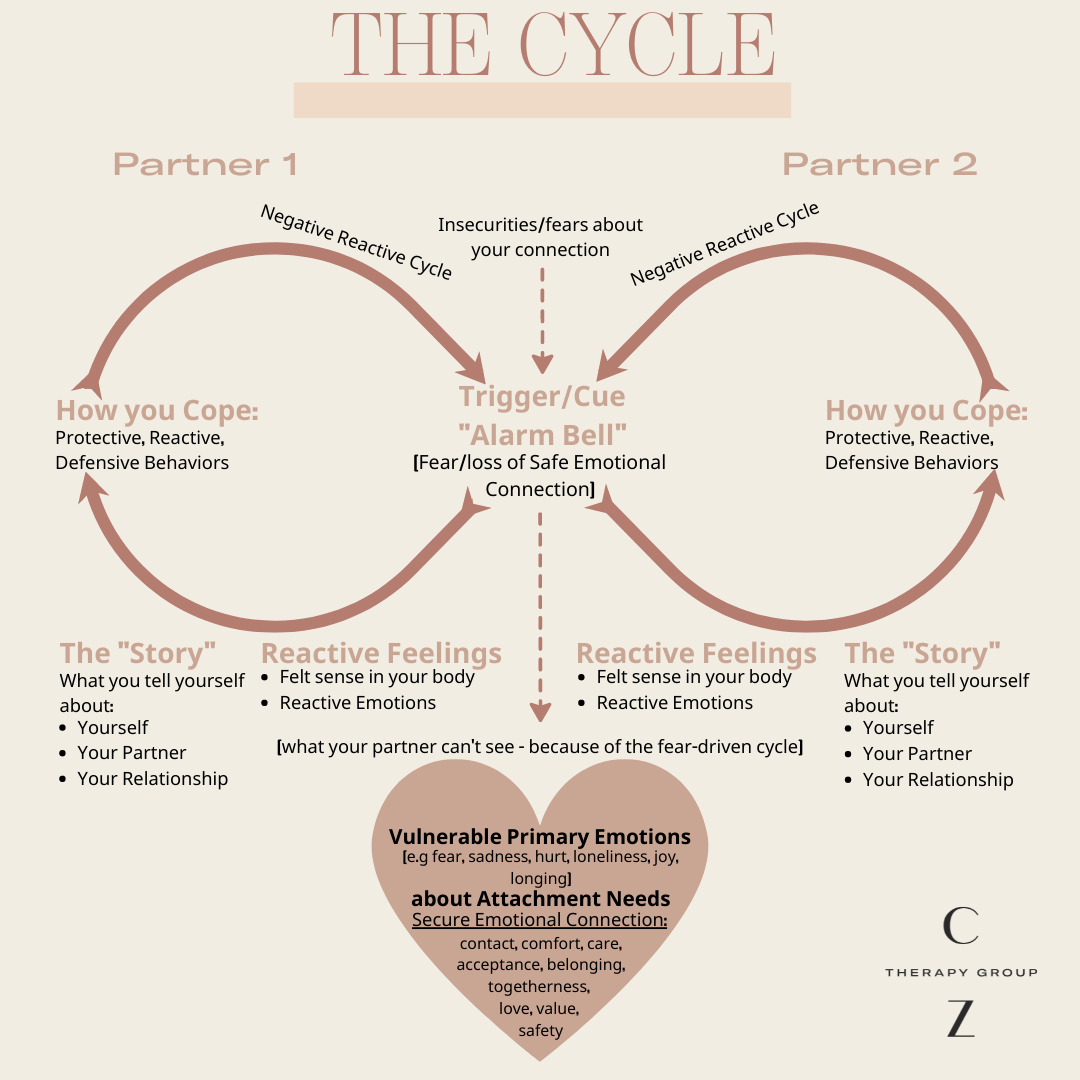
The EFT Cycle provides a framework for understanding these emotional patterns and their impact on communication, as broken down here.
1) How Negative Communication Patterns Form in Relationships
This cycle begins with a triggering event or issue, which leads overwhelming emotions such as fear, anger, or sadness. These emotions then influence our behaviors, causing us to react defensively towards or withdraw from our partner. This, in turn, triggers similar responses from our partner, resulting in a cycle of negative interactions. This cycle can be best depicted by an infinity loop, with no start and no end, that is self-perpetuating until something shifts in the cycle and ceases its continuation.
2) What You’re Really Needing Beneath the Conflict
Beneath the surface of the negative interaction cycle lie unmet attachment needs. These needs may include a desire for validation, support, reassurance, or closeness. Often, couples are not fully aware of these underlying needs, which contributes to the communication breakdown.
3) How Sharing Emotions Changes the Conversation
EFT helps individuals identify and express their deeper emotions, promoting vulnerability and connection. By acknowledging and sharing these emotions with our partner(s), we can foster a greater sense of empathy and understanding, which ultimately helps us break free from the grip of the negative cycle.
4) Creating New Interaction Patterns with a ‘positive cycle’:
Through EFT, couples learn to recognize their negative interaction cycles and replace them with healthier, more constructive patterns. By addressing the root emotions and attachment needs, couples can begin navigating new patterns of secure, attuned communication in order to build a more consistent and loving bond. In EFT couples therapy, the therapist supports this process of engaging in new, positive cycles consistently throughout the process. Repetition is key here in order to create lasting change!
Simple Exercises to Improve Communication in Your Relationship
To enhance your communication skills and strengthen your relationship, try these two simple exercises inspired by EFT couples therapy:
1) Building Connection Through Daily Emotional Check-Ins
Find a quiet space and sit facing each other. Take turns sharing how you are feeling at the present moment. Focus on identifying and expressing your emotions, using words like "I feel..." rather than "You make me feel..." Practice active listening by offering empathy and support to your partner. Avoid judgment or criticism and aim for a genuine connection.
Benefits of Daily Emotional Check-Ins
Emotional Awareness: The exercise encourages both partners to tune in to their own emotions and become more aware of their feelings in the present moment. Many couples struggle with effectively identifying and expressing their emotions, which can hinder effective communication. By engaging in an Emotional Check-In, couples develop a habit of recognizing and articulating their emotions, promoting self-awareness and emotional intelligence.
Enhanced Empathy and Understanding: Sharing how you feel with your partner fosters empathy and understanding. When one partner expresses their emotions, the other partner has an opportunity to actively listen and validate those feelings. This process builds a bridge of understanding, allowing each partner to gain insight into the other's internal experiences. Empathy helps couples establish a more compassionate and supportive connection.
Safe Space for Vulnerability: The Emotional Check-In exercise creates a safe and non-judgmental environment for partners to express their emotions openly. By avoiding criticism or judgment, couples can feel more comfortable being vulnerable and sharing their authentic feelings. This safe space fosters trust and intimacy, as partners learn to rely on each other for emotional support.
Strengthened Emotional Bond: Sharing and listening to each other's emotions builds a deeper emotional connection. It demonstrates that both partners are willing to be present for one another, fostering a sense of validation, validation, and validation. By offering empathy and support during the check-in, couples reinforce their emotional bond and create a foundation of trust and mutual care.
Conflict Resolution and Problem-Solving: The Emotional Check-In exercise can also facilitate conflict resolution. When partners express their emotions honestly, it becomes easier to identify the underlying concerns or triggers. By addressing these concerns in a supportive environment, couples can work together to find constructive solutions. This exercise sets the stage for effective problem-solving and prevents issues from escalating.
Overall, the Emotional Check-In exercise provides couples with an opportunity to create an open, empathetic, and supportive space for emotional expression. By practicing active listening, using "I" statements, and offering validation, couples can deepen their emotional connection, promote understanding, and navigate challenges more effectively.
This exercise, along with other communication tools, can contribute to a healthier and more satisfying relationship.
2) Building Connection Through Appreciation
The “Appreciation Game” is a powerful exercise that focuses on fostering positivity and gratitude within the relationship. It helps couples to recognize and acknowledge the strengths, efforts, and positive qualities of their partner, creating a foundation of appreciation and connection.
Instructions:
1. Set aside dedicated time where you and your partner can focus solely on this exercise without distractions.
2. Sit facing each other and take turns being the speaker and the listener.
3. As the speaker, think of something specific that you appreciate about your partner or a positive action they have taken. It can be a small gesture or a significant quality. For example, "I appreciate how you always take the time to listen to me when I'm feeling overwhelmed."
4. Express your appreciation using "I" statements. Be specific and sincere in your communication. Share how their actions or qualities have positively impacted you or the relationship.
5. As the listener, give your partner your full attention. Maintain eye contact and listen actively without interruption.
6. After the speaker shares their appreciation, the listener repeats back what they heard, paraphrasing and confirming their understanding. This step ensures that both partners are on the same page and that the speaker's message has been accurately received.
7. Switch roles and repeat the process, allowing both partners to express their appreciation.
Benefits of The Appreciation Game
Promoting a sense of gratitude, validation, and emotional connection between partners.
It allows partners to focus on the positive aspects of their relationship and cultivates an atmosphere of support and encouragement.
Regularly practicing this exercise can help couples feel more appreciated and valued, leading to increased intimacy and a stronger foundation for communication.
Remember, effective communication is an ongoing process that requires effort and commitment from both partners. By incorporating exercises like the Emotional Check-In and the Appreciation Game into your routine, you can enhance your communication skills, deepen your emotional bond, and nurture a healthier, more fulfilling relationships.