You've tried the breathing exercises, challenged your anxious thoughts, practiced mindfulness, and reminded yourself that everything is probably going to be okay. And yet, the anxiety keeps coming back.
Perhaps you find yourself anticipating everything that could go wrong, overthinking conversations long after they've ended, or feeling a constant pressure to stay one step ahead. You might recognize that your anxiety feels disproportionate to the situation, but that awareness doesn't necessarily make it any easier to quiet.
So, can anxiety therapy actually help when anxiety feels overwhelming?
Yes. But sometimes, the path toward relief involves changing our relationship with anxiety rather than trying harder to eliminate it.
Through AEDP therapy (Accelerated Experiential Dynamic Psychotherapy), we can begin exploring what our anxiety may be protecting us from feeling, understanding the emotional experiences beneath it, and developing a greater sense of safety and connection within ourselves.
Understanding Anxiety as a Protective Response
Anxiety is part of our body's natural response to perceived danger. Our nervous systems are designed to notice potential threats and prepare us to respond, sometimes before we're consciously aware of what's happening.
This protective system is incredibly important. But when anxiety becomes chronic or overly sensitive, we may find ourselves responding to everyday situations as though something much more threatening is happening, and even feel like we have a lack of agency over how our body and mind respond to certain situations.
A small disagreement might feel like the beginning of a relationship ending. Receiving constructive feedback leaves you questioning your worth. Or the possibility of disappointing someone brings up an overwhelming urge to do more, work harder, or make everything okay.
In these moments, anxiety may be responding to more than the situation immediately in front of us.
Our earlier experiences, attachment relationships, and learned beliefs about ourselves can shape what our nervous systems come to recognize as threatening.
This is one reason why understanding anxiety intellectually doesn't always bring the relief we're hoping for.
Grounding exercises, breathwork, and cognitive strategies can be valuable tools for managing anxiety. But for some of us, we may also need opportunities to explore and fully process the deeply stored emotions and past experiences that keep anxiety feeling so necessary.
How Does AEDP Therapy Help With Anxiety?
In AEDP therapy, we approach anxiety with curiosity rather than treating it as something we need to fight against. When we begin tuning in to our anxiety, we may discover that it has a lot to tell us about our internal world, unmet needs, and the experiences that have shaped how we relate to ourselves and others.
Rather than focusing exclusively on reducing symptoms, we explore what happens inside us when anxiety arises. We pay attention to the sensations in our bodies, the emotions we may be struggling to access, and the protective strategies we've developed to navigate experiences that feel overwhelming.
At the heart of this work is the therapeutic relationship itself.
When our emotional experiences have historically felt unsafe, overwhelming, or lonely, allowing someone into our inner world can feel incredibly vulnerable. But exploring these experiences in the presence of an attuned, emotionally engaged therapist can also offer something deeply transformative.
We aren't meant to navigate our emotional worlds alone. As we begin to experience what it feels like to be seen, understood, and supported in the very places we've learned to protect or hide, we can develop a greater sense of safety within ourselves and in connection with others. Over time, this can create more room for anxiety to soften and for our relationships to deepen.
Through this process, we can build a greater capacity to recognize our emotions, respond to our needs, and move through anxious experiences without feeling completely overtaken by them.
The Change Triangle: Understanding What's Beneath Anxiety
One framework we use in AEDP therapy is The Change Triangle, developed by Hilary Jacobs Hendel.
The Change Triangle helps us recognize three aspects of our emotional experience:
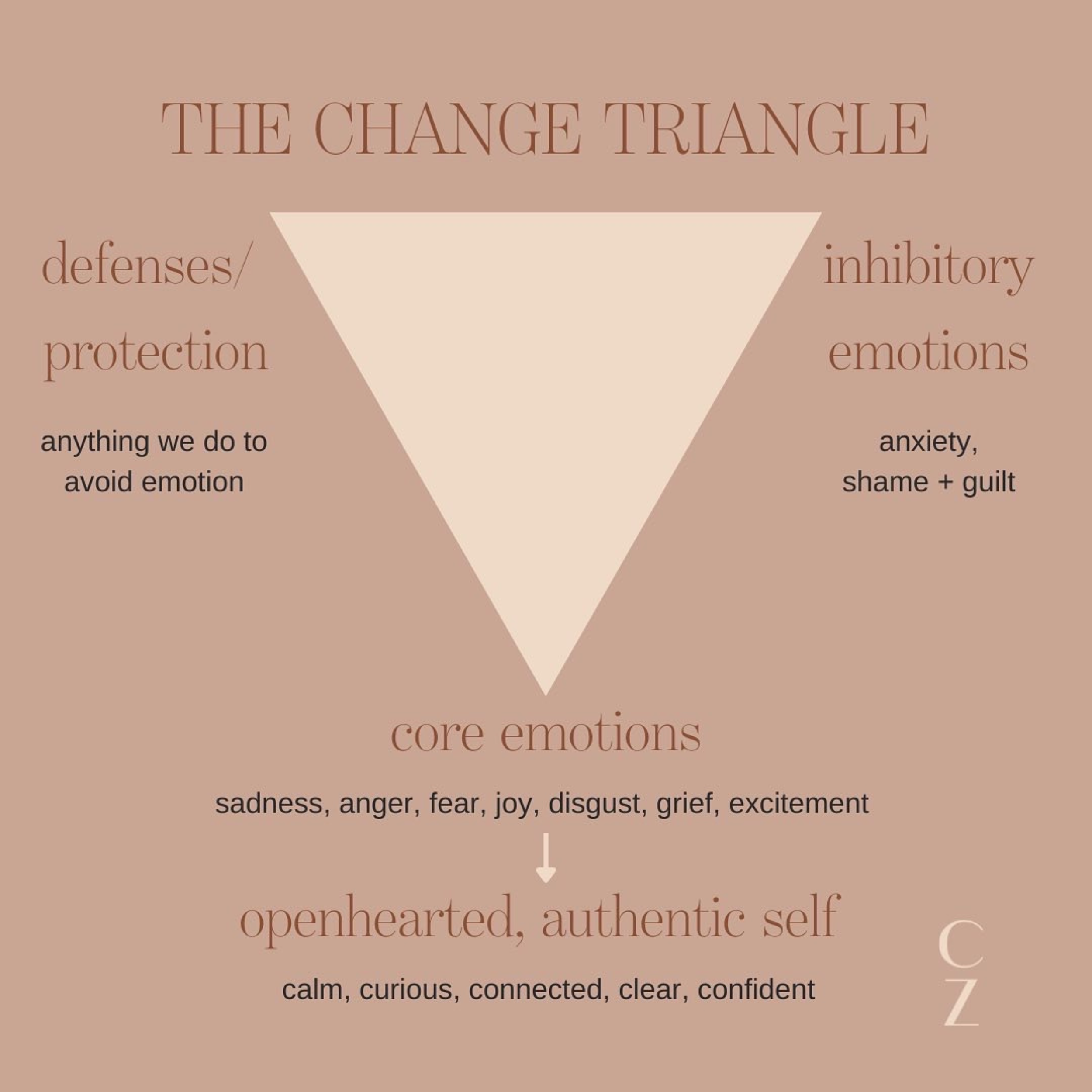
Defenses or protections: Ways we cope with uncomfortable feelings, such as avoidance, overthinking, perfectionism, or becoming defensive.
Inhibitory emotions: Anxiety, shame, and guilt, which can interfere with our access to other emotions.
Core emotions: Feelings like fear, anger, sadness, and joy that carry important information about our experiences and needs.
Within this framework, anxiety can sometimes serve as an inhibitory emotion, making it difficult to access more vulnerable feelings underneath.
For example, we might experience anxiety when someone is disappointed in us, without immediately recognizing the sadness, fear, or anger that the interaction brings up.
Rather than assuming anxiety always has a hidden emotional cause, we get curious about whether there's more to our experience than we're currently able to recognize.
For a deeper explanation of this model, including additional clinical examples, explore our article on the Change Triangle in AEDP therapy.
What Working With Anxiety in AEDP Therapy Can Look Like
Let's explore a fictional client example to illustrate how this work might unfold.
1. Recognizing Anxiety and Protective Behaviors
Katie experiences intense anxiety leading up to her son's piano recitals.
She finds herself becoming unusually critical, insisting that he practice more, worrying about everything that could go wrong, and occasionally considering skipping the recital altogether.
On the surface, Katie seems preoccupied with her son's performance. But in therapy, she begins recognizing just how overwhelmed and frightened she feels in these moments.
Rather than focusing immediately on changing her behavior, Katie and her therapist begin exploring what happens inside when she anticipates the recital.
2. Connecting With the Emotions Underneath
As Katie slows down and begins exploring her anxiety, she shares that her son has recently been bullied at school.
The possibility of him being embarrassed or teased during a public performance brings up a profound sense of fear and sadness.
In therapy, Katie begins noticing how quickly these vulnerable feelings give way to anxious thoughts about preventing something bad from happening.
Her criticism and attempts to control the situation begin to make more sense as efforts to protect her son, and herself, from an experience she fears will be painful.
3. Discovering New Ways to Respond
With her therapist's support, Katie begins making room for the fear and sadness beneath her anxiety.
She can recognize how much she wants to protect her son while also noticing that her efforts to prevent him from being hurt have started creating pressure between them.
As she develops a greater capacity to experience these emotions without immediately reacting to them, Katie may find herself able to respond with more compassion and flexibility.
Instead of automatically insisting that her son practice more, she can check in with him about how he's feeling and what support he might need.
The goal isn't for Katie to stop caring about her son's safety or never feel anxious about his experiences again. It's for her to have more freedom in how she responds when those fears arise.
Anxiety, Control, and the Need to Feel Safe
For many people, anxiety comes with a strong pull to control what's happening around them.
We may plan for every possible outcome, anticipate other people's reactions, or feel responsible for preventing anything uncomfortable from happening.
These efforts can create a temporary sense of relief, but they can also leave us feeling exhausted and increasingly dependent on being prepared for everything.
One useful concept for understanding this experience is our locus of control.
Locus of control describes how much influence we believe we have over the events and outcomes in our lives.
An internal locus of control involves recognizing the influence of our own actions and choices. An external locus of control involves understanding outcomes as largely shaped by circumstances or forces outside our control.
Neither perspective captures every situation. We have meaningful influence over some parts of our lives, while others will always remain uncertain or outside our control.
For those of us who have experienced trauma, this distinction can become especially complicated.
When our safety once depended on anticipating other people's moods, managing conflict, or avoiding mistakes, we may develop a heightened need to control what happens around us. Or we may struggle to recognize the areas where we now have more choice than we once did.
In AEDP therapy for anxiety, we can begin exploring how these patterns developed and what it might feel like to relate to uncertainty differently.
An Exercise for Exploring Anxiety and Control
The next time you notice yourself becoming overwhelmed by anxiety, consider taking a moment to explore what's happening.
1. Notice if you’re feeling out of control
Maybe you're replaying a conversation, trying to anticipate someone's reaction, or feeling compelled to prepare for every possible outcome.
Ask yourself:
What am I trying to prevent from happening right now?
You don't need to judge the answer. Simply notice what your anxiety seems to be working so hard to manage.
2. Get Curious About What Feels Threatening
Consider what it would mean if the situation didn't turn out the way you're hoping.
Perhaps you're worried about disappointing someone, feeling rejected, making a mistake, or being unable to protect someone you love.
You might ask:
What feels most difficult or frightening about not being able to control this outcome?
Sometimes, this question helps us recognize emotional experiences that haven't yet had room for our attention.
3. Recognize Where You Have Choice
Now, gently consider which parts of the situation are within your influence and which are not.
You may not be able to control how another person responds, but you might be able to express your needs, communicate a boundary, ask for support, or decide how you'd like to respond.
And sometimes, the most supportive choice available is to slow down rather than immediately do more.
The goal isn't to convince yourself that uncertainty feels comfortable or that you should be able to control your emotional responses. It's to begin creating space for greater flexibility, self-compassion, and choice.
For additional support with managing intense nervous system activation, you can explore our article on understanding your window of tolerance.
When Coping Skills Aren't Enough
There's nothing wrong with using breathwork, grounding techniques, movement, or other strategies to help manage anxiety. These tools can be incredibly supportive, particularly when we're feeling overwhelmed.
But if you've spent years collecting coping skills and still feel trapped in familiar cycles of overthinking, perfectionism, or self-doubt, it may be worth exploring what's keeping those patterns in place with the support of an anxiety therapist.
Explore AEDP Therapy for Anxiety in Denver
When anxiety has shaped how we move through the world for years, the possibility of experiencing something different can feel both hopeful and unfamiliar.
Through AEDP therapy in Denver, we can explore the experiences beneath your anxiety, develop a greater sense of safety within yourself, and begin creating more room for your own needs, emotions, and choices.
If you're curious about whether our relational, AEDP approach to anxiety therapy might be a good fit, we'd love to connect.