What is Dissociation? Understanding Bodily Responses to Stress from a Trauma Therapist in Denver, CO
By Jordan Kurtz, MA, LPCC, Trauma Therapist in Denver, CO

The word “dissociation” is one with varied meanings depending on its context. In clinical circles, it is defined as disruption or interruption of normal control of motor function, emotion, identity, and perception. Perhaps in less formal settings, a friend may say “Sorry, I was dissociating” to refer to mentally “checking out” when bored or overwhelmed.
As a Denver trauma therapist, I define dissociation from a nervous system lens and also from an adaptive lens. Simply put, dissociation is an act of protection our bodies assume when our nervous system recognizes a high level emotional, mental, or physical threat.
Why do I dissociate?
When exposed to stress, our bodies enter “fight or flight” mode, activating different parts of our nervous system to adequately defend against the threat. Dissociation is a sub-system of this fight or flight response orientation that either can either overly activate or under activate certain behaviors (i.e. why stress makes some people feel restless and others numb). When the stress is severe enough- what most would characterize as a “trauma”- dissociation enters the picture as a survival tool to stop overwhelming sensations, emotions, and thoughts from being processed.
What are the different types of dissociation?
There are two primary classifications of dissociation that relate to how present we feel in our bodies and how intact we feel with our sense of self.
Derealization: disconnect, detachment or sense of non-reality about physical surroundings
Ex: Inability to be in touch with time of day, week, month or year; surrounding objects and people look foggy, distant, or imaginary
Depersonalization: feeling as if one’s thoughts, feelings, and body are unfamiliar, unknown, or not real
Ex: feeling as if you are watching yourself from an outsider’s perspective
How does dissociation feel?
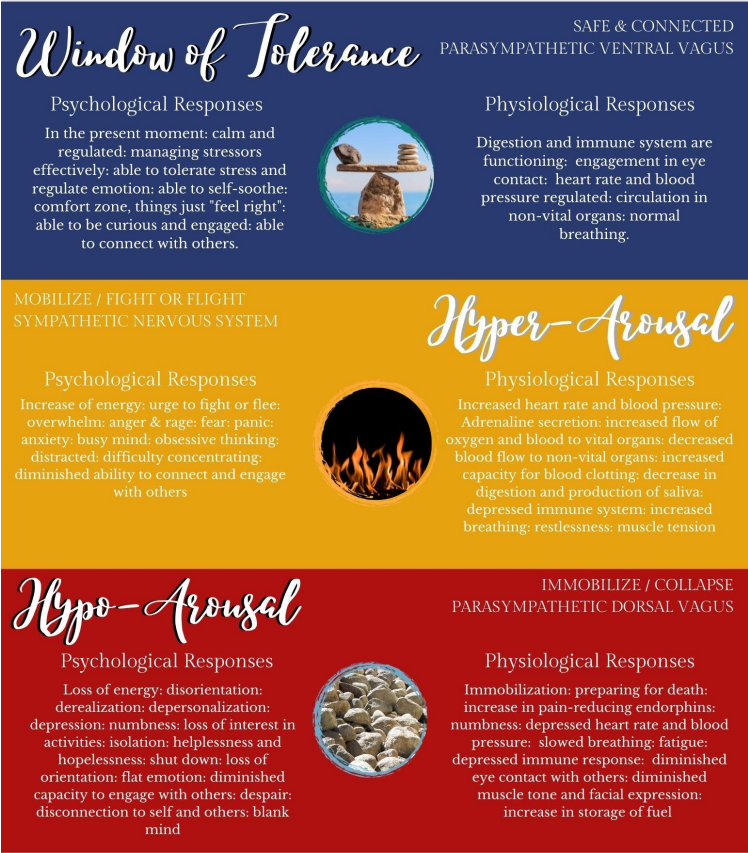
Window of Tolerance (Where we aim to operate!): state of open-heartedness, lack of reactivity, and calm that facilitates effective management of stressors and safe connectivity with self and others.
Emotional state: curious, relaxed, non-judgmental, regulated, balanced
Physiological state: normal breathing, ability to maintain eye contact, relaxed body posture, steady heartbeat
Hyper-arousal (Mobilize Fight or Flight): high energy state that propels impulses to fight or flee, minimizing capacity to connect with others due to a distracted and racing mind and/or body.
Emotional state: overwhelmed, anger, panic, anxiety, obsessive thinking, distracted
Physiological state: increased heart rate and blood pressure, rapid breathing, restlessness, muscle tension
Hypo-arousal (Freeze/Collapse): loss of energy ranging to total shutdown of emotional, mental and physical responses resulting in disconnect from self, sensations, and others.
Emotional state: numbness, isolation, depersonalization, derealization, hopelessness
Physiological state: slowed breathing and heartrate, fatigue, heaviness, minimal affect
How does trauma therapy help with dissociation?
Normalizing dissociation as a survival tool
Identifying how dissociation manifests, its triggers, and associated emotions and behaviors
Allowing your therapist to serve as a physical and emotional anchor during times of disconnect from self and body
Retraining the nervous system to engage with overwhelming emotions, sensations and thoughts adaptively
Begin Trauma Therapy in Denver
If you’re experiencing dissociation, consider exploring trauma therapy in Denver, CO at CZ Therapy Group. Follow these three simple steps to get started:
Reach out to schedule a free 20-minute consult call to see if trauma therapy is right for you
Connect with the CZTG trauma therapist of your choice via a phone consult.
Begin the process of nervous system regulation with Denver trauma therapy!
Meet The Writer: Jordan Kurtz, Denver Trauma Therapist
Jordan Kurtz (she/her) is a trauma and relationship therapist at CZTG who focuses on therapy for grief, trauma, adolescence, and couples. Jordan is authentic, warm, and affirming of her clients’ identities and experiences.