If you've experienced intense stress or trauma, you've probably had moments where your body seemed to take over completely, and not in a way that made any sense to you.
Maybe it felt like anxiety pulling the wheel. Your heart pounding, your chest tight, your breath coming in shallow waves, your whole body humming with a tension you couldn't shake. Or maybe it went the other direction entirely, and instead of feeling wired, you felt nothing. Numb, foggy, disconnected, like you were watching your own life from somewhere far away. Sometimes the memory of what happened gets blurry too, or disappears altogether.
If you've experienced both of these at different points, you're in good company. Most of us don't fall neatly into one camp. Our bodies are constantly making split-second decisions about what kind of protection we need, and those decisions can look really different depending on the moment.
What a lot of people don't realize is that none of this is random, and it's definitely not "just in your head." These responses are deeply rooted in your nervous system, quietly running the show in the background and shaping how your body responds to stress, danger, and overwhelm in real time.
So what's actually happening beneath the surface? Why does your body seem to react before your brain even gets a chance to weigh in?
That's exactly what we're going to explore together. And here's what we can tell you upfront: once you understand how your nervous system responds to trauma, so much of what has felt confusing, frustrating, or even frightening about your own reactions starts to finally make sense.
How the Nervous System Responds to Trauma
To understand why your body reacts the way it does, it helps to start with the basics of how your nervous system actually works. You don't need a science degree for this, we promise. But having a simple framework to hang these experiences on can make a world of difference, both in how you understand yourself and in how you start to heal. Here's what's going on under the hood.
Your Nervous System Is Designed to Protect You
Here's the most important thing to take away from this entire post: your body is not working against you. Your body's primary goal, above everything else, is to keep you alive.
When something feels threatening, whether that's physical danger or emotional overwhelm, your nervous system automatically shifts into a protective response. This happens fast, and it happens well outside of your conscious control. You don't think your way into these reactions. They're built-in, hardwired responses that kick in automatically because your body doesn't have time to wait around for you to weigh your options.
It can feel jarring, confusing, or even embarrassing when your body responds in ways you didn't choose. But those responses have a purpose. They're not signs that something is broken in you. They're signs that your body has been paying attention and doing its job. These are the same signs we listen closely to in trauma therapy. They guide our entire process and are an invaluable part of the work.
Why Your Body Reacts Before You Can Think
The part of your body running this whole operation is called the autonomic nervous system. It controls the automatic processes you never have to think about, like your heart rate, breathing, and digestion.
It’s always scanning for cues of safety or danger—often without you even realizing it. And when something feels off, your body doesn’t wait for your logical brain to catch up. It reacts first.
That’s why you might feel anxious, shut down, or frozen before you can even make sense of what’s happening. Your nervous system has already made a decision about your safety.
At its core, it’s asking one constant question: Am I safe right now?
How your body answers that question shapes everything about how you feel, respond, and move through the world in that moment.
The Polyvagal Ladder: Mapping Your Internal World
One helpful way to understand how your nervous system works is through something called Polyvagal Theory, which describes three distinct states your nervous system moves between. Think of it as a ladder with three rungs—and all of us move up and down this ladder throughout our days. That's completely normal and healthy.
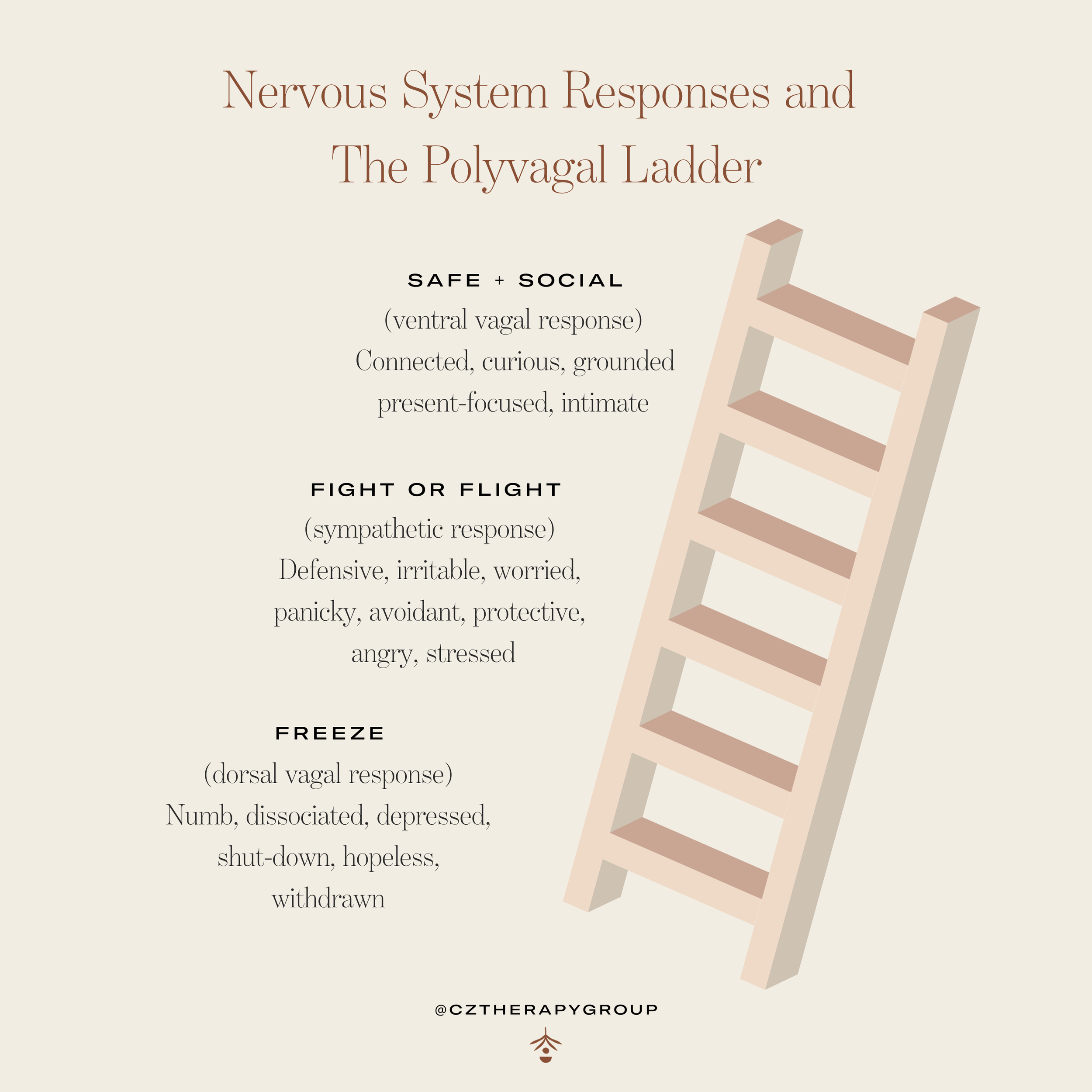
Here's what each rung feels like:
The Freeze/Shutdown State (Bottom of the Ladder)
At the bottom of the ladder is the freeze or shutdown response. This is when your body decides that the threat in front of you is so overwhelming that there's no point in fighting or running—so instead, it essentially plays dead.
This can feel like:
Numbness or emotional flatness
Dissociation or feeling disconnected from your surroundings
Depression or deep withdrawal
Difficulty thinking clearly
Trouble remembering what happened
If you've ever experienced trauma that you now struggle to remember, this is likely why. Your brain made a judgment call that what was happening was simply too much—and it shut you off from it to keep you safe. That can feel frustrating or unsettling, but it's actually a remarkably adaptive response. Your body knew what it was doing.
The Fight-or-Flight State (Middle of the Ladder)
One rung up is the fight-or-flight response. This is where your body prepares to take action—either to confront the threat or escape it.
This can feel like:
A racing or pounding heart
Faster or shallow breathing
Muscle tension, especially in your limbs
Restlessness, agitation, or feeling "amped up"
Tunnel vision—like you can only focus on the threat right in front of you
The tunnel vision piece is intentional. Your body is essentially saying, forget everything else—just deal with this. Even when there's no immediate physical danger, your body can still activate this response when something feels unsafe or overwhelming on a deeper level.
The Safe/Social State (Top of the Ladder)
At the top of the ladder is what we call the Safe/Social state—and this is where we all want to spend more time.
In this state, you feel calm and grounded. You're able to think clearly, connect with others, and approach problems with curiosity instead of panic. This is actually the state you need to be in to effectively navigate modern-day stress and challenges.
But here's the honest truth: it's usually not where we naturally land when life gets hard. If your nervous system has a history of needing to protect you, it tends to default to the lower rungs first. Getting back to Safe/Social, and staying there more consistently, often involves healing the underlying experiences that trained your system to react the way it does.
Why You Might Move Between All Three
Your nervous system is constantly adapting based on what feels safest in any given moment. Sometimes activation feels more protective. Other times, shutting down feels like the only way through. Moving between these states isn't a red flag. It's actually a sign that your nervous system is doing exactly what it was designed to do.
If you notice your body tends to jump into fight-or-flight or freeze pretty often, that's likely because you've had experiences that trained it to respond that way. Your body learned those patterns for a good reason, and it's been trying to protect you ever since.
The tricky part is that sometimes those same responses show up even when the original threat is long gone. A smell, a tone of voice, a certain look on someone's face, and suddenly your body is reacting as if you're back in that moment. That's not you being dramatic or oversensitive. That's a nervous system that got really good at detecting danger and is now a little too quick on the trigger. It can also work the other way, where the body gets stuck in a low, shut-down state and has a hard time climbing back up even when things are actually okay.
This is where somatic trauma therapy can make a real difference. Combined with some simple regulating practices you can use at home (more on those below), it can help you build genuine agency over how your body responds in the present, not just understanding why it reacts the way it does, but actually being able to shift it when you need to.
Tending to Your Nervous System: Small Ways to Return to Center
Here's the good news: once you start recognizing what each state feels like in your own body, you can begin to work with your nervous system instead of feeling hijacked by it. The goal is usually to find your way back to Safe/Social—and there are some surprisingly simple ways to help your body get there.
A helpful rule of thumb: if you're frozen, you need to heat up. If you're in fight-or-flight, you need to cool down.
If you're in Freeze/Shutdown — try warming up:
Use a heating pad or drink something warm
Move your body—shake it out, dance, go for a walk
Stimulate your senses with something bold: spicy food, upbeat music, or strong scents like eucalyptus or cinnamon
If you're in Fight-or-Flight — try cooling down:
Hold an ice pack to your forehead, splash your face with cold water, or soak your feet
Try slow diaphragmatic breathing to signal safety to your brain
Move your eyes slowly around an imaginary clock face (12, 3, 6, 9)—this counteracts tunnel vision and tells your brain the threat has passed
These techniques work because they give your nervous system real, physical information that you're actually safe. Your brain listens to your body—so when you change what your body is doing, your brain starts to get the message.
You Don’t Have to Carry the Weight of This Alone
Understanding your nervous system is a powerful first step. But if you find yourself stuck in these lower states often—or if trauma is making it hard to feel safe in your own body—working with a trauma-informed therapist can help you find your way back to a body that feels like home.
If you're looking for trauma therapy in Denver, we'd love to connect. Reach out today for a free 20-minute consult and get matched with a therapist on our team who can help you find your way to a regulated, authentic way of being.
Ready to start? Here's how:
Reach out to schedule a free 20-minute consult call.
Connect with the Denver therapist of your choice.
Begin your healing journey.